GAME GUIDE
Coin Othello: first moves, corners, and practice
Read the face, not the denomination
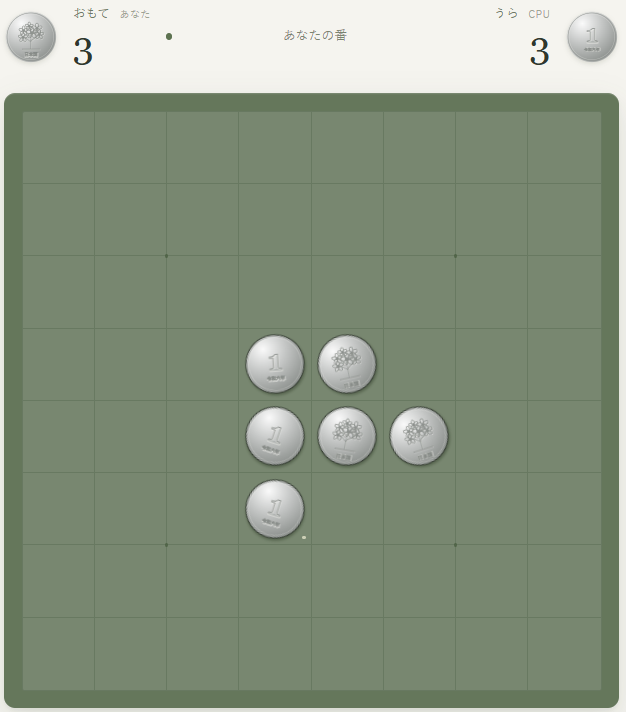
You score faces, not money. Confirm whether you control fronts or backs before choosing a move. Holding peek temporarily shows fronts in white and backs in black, so you can check the position before learning every coin design.
Verify the first move with coordinates
Label columns A–H from left to right and rows 1–8 from top to bottom. In a fresh game, D4 and E5 are backs; E4 and D5 are fronts. Playing a front at D3 flips D4, which lies between D3 and D5. Mere adjacency does not flip a coin, and a gap breaks the line.
This example applies to a new board, rather than a saved game in progress. Turn on hints and check where the friendly face at the other end of each line lies.
Check the reply before playing next to a corner
A captured corner cannot be bracketed from outside the board. A nearby square does not have the same protection. With A1 empty, a move at B2 may allow a diagonal capture into A1, depending on the rest of the line.
Compare how many faces you flip now with the moves you give the opponent next. The aim is not simply to have fewer coins early: it is to preserve useful choices and secure faces that can survive to the end.
A pass is different from the end of the game
If only one player has no legal move, that player passes automatically. If both have no legal move, the game ends. Check the front and back counts in the result rather than assuming every square must be filled.
Change one practice condition at a time
- Use one denomination with hints and peek to learn legal moves.
- Play solo and observe where the CPU moves after each of your turns.
- Use the undo control to revisit a missed response and look for an alternative that does not give away a corner.
- Try mixed coins once the move-selection process feels familiar.
For two players, select the local two-player mode and take turns on one screen. It does not connect two distant devices.